



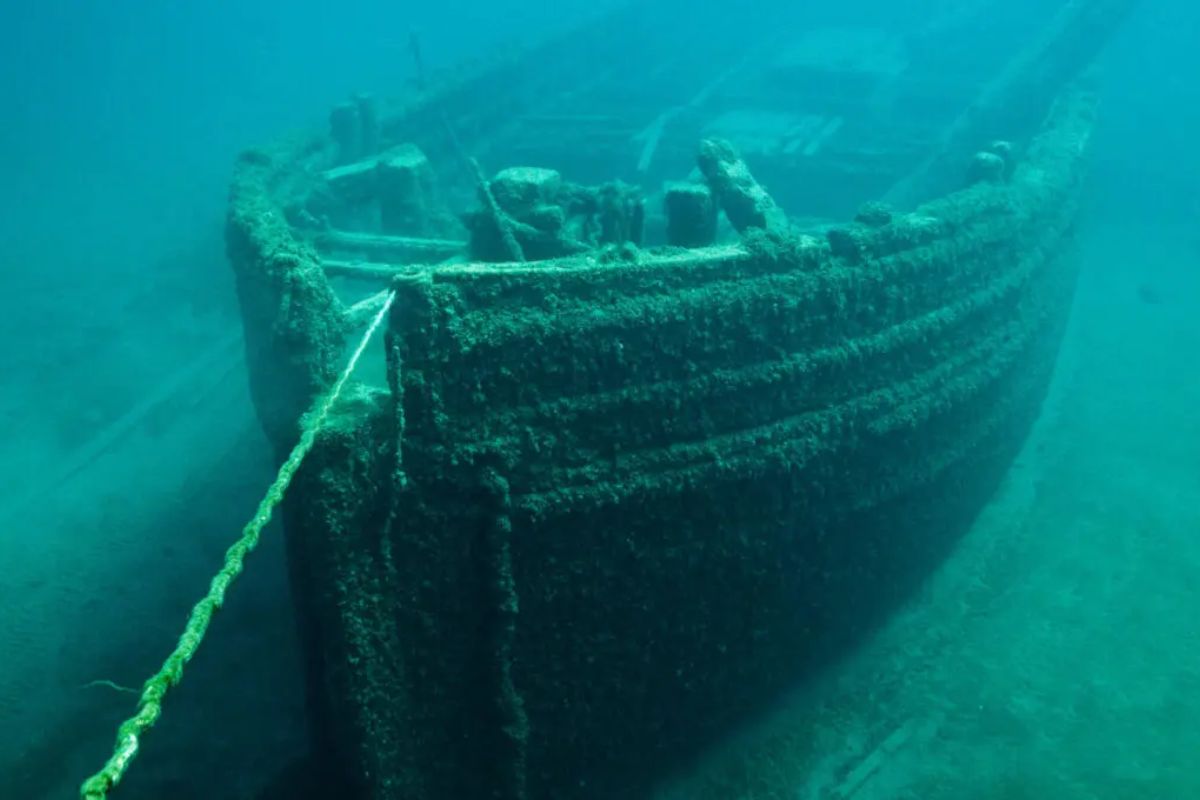
Did you know that Lake Erie, one of North America's Great Lakes, is home to over 2,000 shipwrecks? This freshwater giant has witnessed countless maritime adventures, many ending in tragedy. From schooners to steamships, these vessels now rest beneath the waves, each with a story to tell. Some shipwrecks date back to the 19th century, offering a glimpse into the past. Divers and historians alike are fascinated by these underwater time capsules. Whether you're a history buff or just curious, learning about Lake Erie's shipwrecks can be both thrilling and educational. Ready to dive into some intriguing facts? Let's get started!
Lake Erie: A Treacherous Waterscape
Lake Erie, one of the five Great Lakes of North America, has a storied history filled with tales of shipwrecks. Its shallow waters, unpredictable weather, and busy shipping lanes have made it a hotspot for maritime disasters. Here are some fascinating facts about the shipwrecks that lie beneath its surface.
-
Lake Erie is the shallowest of the Great Lakes, with an average depth of just 62 feet. This makes it more susceptible to sudden and violent storms, contributing to numerous shipwrecks.
-
Over 2,000 shipwrecks are estimated to lie at the bottom of Lake Erie, making it one of the most shipwreck-dense bodies of water in the world.
-
The first recorded shipwreck on Lake Erie occurred in 1679 when the French vessel Le Griffon disappeared without a trace. Its fate remains one of the great maritime mysteries.
Famous Shipwrecks
Some shipwrecks in Lake Erie have become legendary due to their historical significance or the mystery surrounding their sinking.
-
The SS Edmund Fitzgerald, though more famous for sinking in Lake Superior, had a sister ship, the SS Arthur M. Anderson, which frequently sailed Lake Erie. The Anderson was the last to have contact with the Fitzgerald before it sank.
-
The G.P. Griffith, a passenger steamer, caught fire and sank in 1850, resulting in the loss of over 240 lives. It remains one of the deadliest maritime disasters on the Great Lakes.
-
The Anthony Wayne, a sidewheel steamer, exploded and sank in 1850. The wreck was discovered in 2006, nearly 156 years later.
The Role of Weather
Weather has played a significant role in many of Lake Erie's shipwrecks. Sudden storms and fog can turn a routine voyage into a perilous journey.
-
The "Black Friday Storm" of 1916 caused the sinking of four ships and the loss of 49 lives. It is one of the most devastating storms in Lake Erie's history.
-
In 1909, the wooden steamer Clarion was caught in a dense fog and collided with another vessel, leading to its sinking.
-
The 1913 Great Lakes Storm, also known as the "Big Blow," caused the loss of 12 ships on Lake Erie alone, with many more damaged.
Shipwreck Discoveries
Modern technology has allowed for the discovery and exploration of many shipwrecks that were once lost to history.
-
The wreck of the James H. Reed, a wooden schooner, was discovered in 2008. It had been missing since it sank in 1905.
-
In 2015, the wreck of the Argo, a tanker that sank in 1937, was found. It was carrying a cargo of benzol, a toxic chemical, making its discovery significant for environmental reasons.
-
The schooner Plymouth, which sank in 1852, was discovered in 1991. It is one of the best-preserved shipwrecks in Lake Erie.
Shipwrecks and Archaeology
Shipwrecks provide a unique window into the past, offering insights into the lives of those who sailed the Great Lakes.
-
The wreck of the Sultan, a wooden steamer that sank in 1864, has yielded numerous artifacts, including personal items of the crew and passengers.
-
The Indiana, a steamer that sank in 1858, was found with its cargo of grain still intact, providing a snapshot of 19th-century trade.
-
The wreck of the Dundee, a schooner that sank in 1900, has been a treasure trove for maritime archaeologists, revealing details about shipbuilding techniques of the era.
Environmental Impact
Shipwrecks can have both positive and negative impacts on the underwater environment.
-
Many shipwrecks have become artificial reefs, providing habitat for fish and other marine life. The wreck of the Niagara, a steamer that sank in 1856, is now a popular spot for divers due to the abundance of fish.
-
Some shipwrecks, like the Argo, pose environmental hazards due to the toxic cargo they were carrying when they sank.
-
The wreck of the Benson Ford, a freighter that sank in 1959, has become a popular diving site, but concerns remain about the potential release of pollutants from its cargo.
Preservation Efforts
Efforts are being made to preserve these underwater time capsules for future generations.
-
The National Museum of the Great Lakes in Toledo, Ohio, plays a crucial role in preserving and interpreting the history of Lake Erie's shipwrecks.
-
The Great Lakes Shipwreck Historical Society conducts underwater surveys and works to document and protect shipwreck sites.
-
In 1987, the state of Ohio established the Lake Erie Submerged Lands Preserve to protect shipwrecks and other underwater cultural resources.
Shipwreck Legends and Myths
Shipwrecks often give rise to legends and myths, adding an element of mystery to Lake Erie's maritime history.
-
The ghost ship of Lake Erie is a popular legend. Some claim to have seen a spectral ship sailing the waters on foggy nights, believed to be the lost Le Griffon.
-
Stories of buried treasure associated with shipwrecks abound. One such tale involves the Marquette & Bessemer No. 2, a car ferry that disappeared in 1909, rumored to have been carrying a valuable cargo.
-
The legend of the "Storm Hag," a mythical creature said to dwell in Lake Erie, is believed by some to be responsible for the sudden storms that have caused many shipwrecks.
Modern-Day Exploration
Advancements in technology have made it possible to explore and document shipwrecks like never before.
- Remote-operated vehicles (ROVs) and sonar mapping have revolutionized the search for shipwrecks, allowing for detailed exploration without the need for divers.
The Final Word on Lake Erie Shipwrecks
Lake Erie’s shipwrecks offer a fascinating glimpse into maritime history. From the tragic tales of lost vessels to the mysteries still hidden beneath the waves, these underwater relics tell stories of bravery, tragedy, and adventure. They’re not just rusting hulks; they’re time capsules preserving moments from the past. Exploring these wrecks, whether through diving or research, connects us to the sailors and passengers who once navigated these waters. Each shipwreck has its own unique story, adding depth to our understanding of the Great Lakes’ rich history. So, next time you gaze out over Lake Erie, remember the secrets lying beneath its surface. They’re waiting to be discovered, each one a piece of the puzzle that makes up the lake’s storied past. Dive into the history, and let your imagination sail through time.
Was this page helpful?
Our commitment to delivering trustworthy and engaging content is at the heart of what we do. Each fact on our site is contributed by real users like you, bringing a wealth of diverse insights and information. To ensure the highest standards of accuracy and reliability, our dedicated editors meticulously review each submission. This process guarantees that the facts we share are not only fascinating but also credible. Trust in our commitment to quality and authenticity as you explore and learn with us.